
Veengu
Home / Platform / System of record

A trusted system of record for fintech.

In banking, a system of record is a centralised database or platform that serves as the authoritative source of data for a particular type of information within an organisation — the primary repository where critical and official data related to banking operations and transactions are stored.

Cloud-native architecture, real-time, API-first, low-cost technology stack.

Veengu System of Record for fintech, cloud core banking for fintech
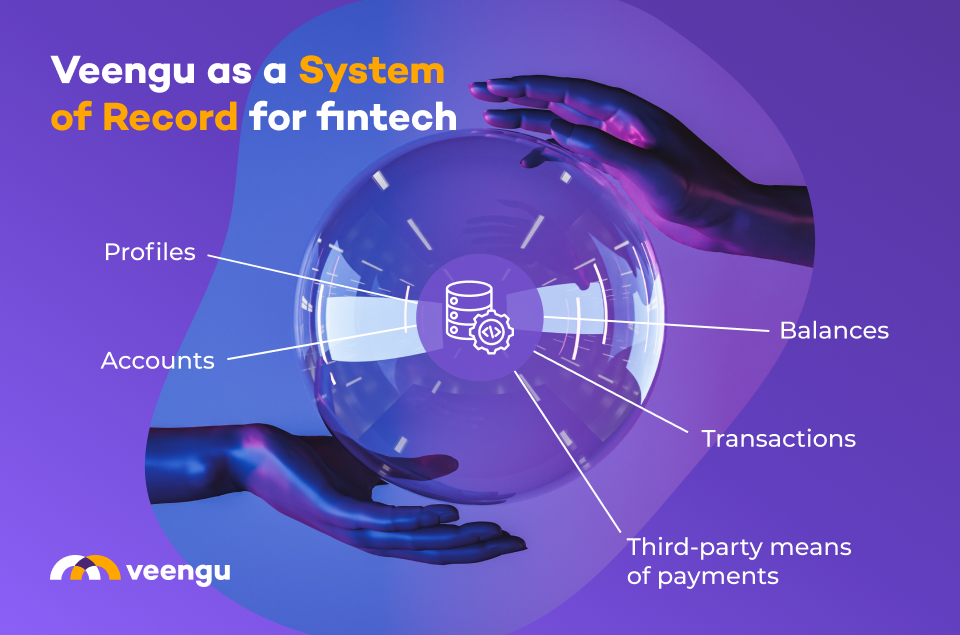
Fig. 1 · System of record for fintech
Background

What a system of record is, and what it is for.

The system of record for fintech is designed to ensure the accuracy, consistency and reliability of data. It is typically used to manage essential information such as customer account details, transaction history, balances, and other financial records. This system is crucial for regulatory compliance, financial reporting, and auditing purposes.

For example, in a bank, the core banking system is often considered the system of record for customer accounts. It maintains up-to-date and accurate information about account balances, transaction history, and other relevant details.

When it comes to choosing a system of record for fintech, there are several well-known options in the market. Some of the notable contenders include solutions from Oracle Financial Services, FIS, and Temenos. Each comes with its own features and benefits, catering to different aspects of banking and fintech operations.

In recent years, Veengu has emerged as a standout choice, offering a range of features that make it an exceptionally well-suited system of record for fintech companies. Veengu is a core banking system for fintech companies. It provides a centralised repository for customer data, empowering fintech companies to efficiently manage and access critical information, such as customer profiles, accounts, transactions, and more.

Centralised repository

What the system of record holds.

The data that lives in the system of record is the data your finance team reconciles against, your regulator audits, and your downstream systems read from.

Customer profiles

Demographic information, KYC artefacts, links to accounts and other objects.

Accounts & balances

Current, wallet, merchant, nostro and vostro accounts — multi-currency from day one.

Transaction history

Immutable postings — every state change carries who, what, when, and why.

Postings & settlement

Double-entry transfers, end-of-day snapshots, reconciliation against external cores.

Audit trail

Every action logged and queryable from the operator back office. Built for auditors.

Regulatory outputs

Real-time regulatory reporting outputs flow from the SoR — not bolted on later.

Why Veengu

Why Veengu is the top choice as a system of record for fintech.

Six compelling reasons fintech operators pick Veengu when picking the authoritative layer for customer data.

01

Data validation, accuracy and integrity.

The system of record exists to be the authoritative source — built around the contracts that keep data trustworthy.

02

Scalability.

Veengu can scale to meet your needs, ensuring uninterrupted service and performance.

03

Security.

Encryption and access-control measures shield sensitive financial data from unauthorised access and cyber threats.

04

Regulatory compliance.

Veengu is purpose-built with compliance in mind. It simplifies adherence to industry-specific regulations and reporting standards.

05

Real-time data accessibility.

Up-to-the-minute information for customer applications, risk management, and customer support.

06

Open APIs and integration.

Designed with open APIs and integration capabilities, ensuring compatibility with various third-party applications and services.

By implementing Veengu as your system of record, you position your fintech company for success — meeting customer expectations, complying with regulatory requirements, and staying at the forefront of the ever-evolving world of financial technology.
Your partner in financial innovation

A centralised repository for customer data — and the platform underneath.

Veengu provides a centralised repository for customer data, empowering fintech companies to efficiently manage and access critical information — customer profiles, accounts, transactions, and more.

A comprehensive software suite, configurable to implement your vision with our platform and professional services. Build unique fintech solutions across the world with our modular, cloud-native platform.

Veengu Payment Software for wallets & e-money, banks & fintech
Comparison

Veengu vs. traditional core banking systems.

How Veengu compares with traditional core banking platforms in the fintech industry — the likes of Oracle Financial Services, FIS, and Temenos. Nine reasons Veengu is considered the best system of record for fintech.

01 Reason

Cloud-Native Advantage

Veengu operates entirely in the cloud, which means it leverages the latest development frameworks right from the start. Unlike traditional software houses that may have legacy systems to manage, Veengu doesn’t have to deal with the complexities of previous migration journeys. This allows for more agile and efficient development.

02 Reason

No Legacy Burden

By following a “no legacy” principle, Veengu can utilise modern solutions like smart contracts and real-time data without the traditional cost burdens associated with code development. This leads to cost-effective and faster deployment of financial products.

03 Reason

Real-Time Insights

Veengu is capable of providing real-time insights not only to customers but also to downstream systems, including regulatory reporting outputs. This ensures accurate and up-to-date information about customer accounts and business lines at any given time.

04 Reason

Strong Engineering Team

Veengu boasts one of the best engineering teams in the industry, consisting of experts from both the banking community and leading technology players. This blend of talent ensures that the platform is equipped to handle the evolving needs of the fintech industry.

Learn more
05 Reason

API-First Approach

Modern APIs are crucial in a digital financial ecosystem. Veengu ensures that there are APIs for every aspect of the account journey — from creation to dormancy to closure. This allows for seamless integration with other services and applications.

Learn more
06 Reason

Scalability and Robustness

The scalability and robustness of Veengu’s APIs are rigorously tested through automated processes. This ensures that the platform can handle increasing demands and maintain a high level of performance.

07 Reason

Componentization and Containerization

Veengu supports componentization and containerisation, allowing for modular deployment of functionality. Basic features can be quickly implemented, and new functionalities added as business needs evolve.

08 Reason

Avoiding Vendor Lock-In

Veengu encourages the review of vendor lock-in, whether it relates to hardware or cloud providers. This ensures banks and fintech companies have the flexibility to adapt to changing technology landscapes.

09 Reason

Compatibility with Open Source Platforms

Veengu is compatible with open-source databases, event architecture, and API management. This aligns with the industry trend towards open-source solutions, providing more flexibility and customisation options.

Learn more
In summary, Veengu stands out as the best system of record for fintech and core banking platform for fintech — due to its cloud-native architecture, real-time capabilities, strong engineering team, API-first approach, and compatibility with modern technologies. A forward-looking solution that addresses the evolving needs of the fintech industry.
Future-proof

A forward-looking solution for an evolving fintech industry.

Veengu empowers financial institutions with cutting-edge tech solutions. Build unique fintech offerings across the world with our modular, cloud-native platform.

Discuss your platform scope.

Bring your regulatory licence, target geographies, expected scale, and integration constraints. We respond within three business days.

Book a demo Send your scope