
Why core financial software must connect digital accounts to agents, merchants, local payment networks and the physical economy.
Digital financial services are expanding rapidly across Africa. Yet this growth does not mean that cash has disappeared. In many markets, cash and digital money operate together: customers deposit cash through agents, transfer value digitally and later withdraw it as cash or spend it with a merchant.
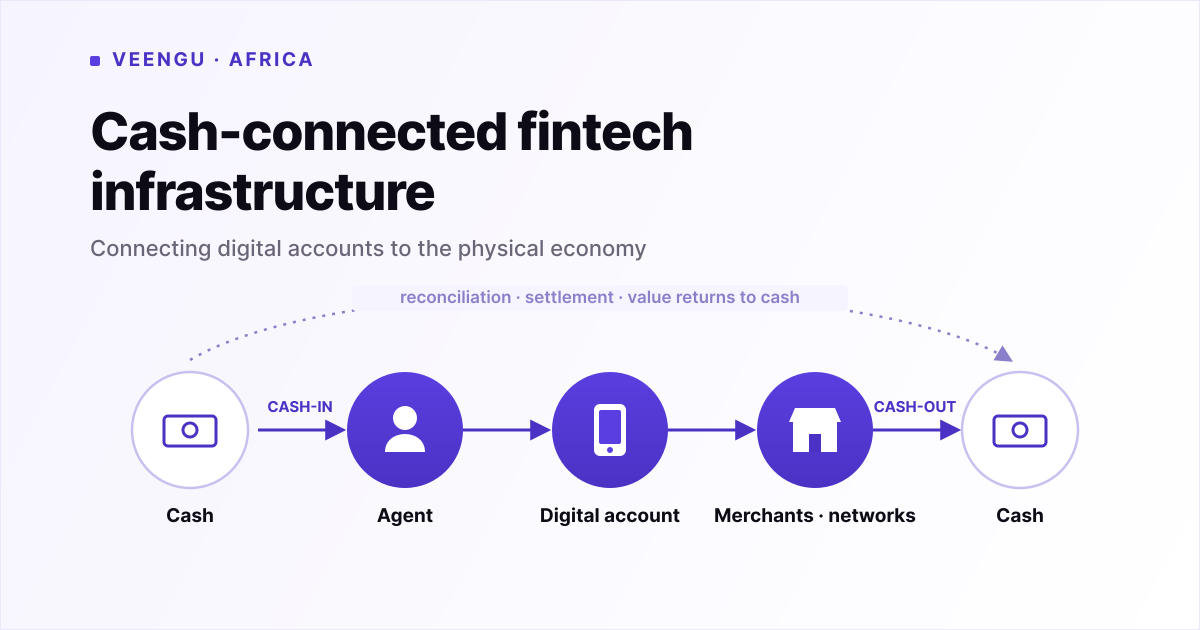
This creates a different starting point for fintech infrastructure.
In a predominantly account-based market, a new financial service can often assume that customers already hold bank accounts from which they can fund the product electronically. In a cash-intensive or mobile-money-led market, the provider may first need to establish the mechanisms through which physical cash becomes regulated digital value.
The core platform must therefore do more than maintain customer accounts and process bank transfers. It may also need to support agents, cash-in and cash-out, commissions, local payment integrations, merchant acceptance, reconciliation and operational exceptions.
The distinction is not simply “Africa versus Europe.” African markets differ substantially from one another. The more useful distinction is between an account-centric financial system and a cash-connected, multi-network ecosystem.
Africa is not one payments market
Any discussion of African fintech must begin with an important qualification: there is no single African operating model.
Kenya, Ghana, Tanzania and Uganda have well-established mobile-money ecosystems. Nigeria combines widespread bank transfers and instant payments with a large agent-banking sector. South Africa has comparatively developed banking and card infrastructure. Other countries may depend more heavily on cash, have limited interoperability or rely on a small number of banks and mobile-money providers.
The common feature is not that every African economy is exclusively cash-based. It is that many providers must operate across several forms of value simultaneously:
- physical cash;
- mobile money and electronic money;
- commercial-bank balances;
- merchant and agent balances;
- domestic payment networks;
- remittance flows;
- and, in some markets, multiple currencies.
This hybrid structure has become commercially significant. According to the World Bank’s Global Findex 2025, account ownership in Sub-Saharan Africa increased from 49% of adults in 2021 to 58% in 2024, with mobile-money use at the highest level of any region.
At the same time, digital acceptance remains incomplete. World Bank analysis based on the same data indicates that only about 20% of adults in Sub-Saharan Africa made a digital merchant payment during the previous year. Cash therefore remains central to everyday commerce even as digital account ownership grows. This is the same structural challenge we describe in our work on de-fragmenting African payment markets.
Mobile money often creates a digital layer over cash
A mobile-money transaction may be digital, but its lifecycle frequently begins or ends with physical cash.
A typical cash-in transaction works as follows:
- A customer gives cash to an agent.
- The agent’s electronic balance is adjusted.
- The customer’s wallet balance increases.
- The customer can transfer or spend the electronic value.
Cash-out reverses the process:
- The customer’s wallet is debited.
- The agent’s electronic balance is adjusted.
- The agent gives physical cash to the customer.
The software records the digital entries, but the agent performs the physical exchange. This makes the agent part of the service-delivery infrastructure — not merely a sales or customer-acquisition channel. It is a point we explore in more detail in driving banking access with the Veengu agent app.
Mobile money has reached substantial scale. The GSMA’s regional report for 2024 reported transaction values of $649 billion in East Africa and $357 billion in West Africa. The same report also shows significant differences in adoption and activity among African subregions.
The lesson for technology providers is straightforward: mobile money should not be treated as a single, uniform payment method. Each market has its own providers, agent structures, regulatory rules, settlement models and levels of interoperability.
Why SWIFT is rarely the whole answer
SWIFT can remain important for correspondent banking, treasury operations and international bank-to-bank payments. However, it is seldom the principal rail for low-value domestic retail transactions.
Similarly, a European fintech launch involves much more than connecting to SEPA. Card processing, open banking, safeguarding, local instant-payment schemes, fraud controls and reconciliation may all be required.
The real difference is the assumption about how customers access the service.
In an account-centric system, customers can usually fund a new account through an existing bank. In a cash-connected market, a fintech may need integrations with:
- mobile-money operators;
- domestic instant-payment systems;
- bank-transfer networks;
- agent networks;
- bill-payment aggregators;
- remittance providers;
- card or national switches;
- identity services;
- and USSD, SMS or other telecom channels.
The priority is determined by the domestic ecosystem rather than by a standard international integration checklist.
Interoperability is also becoming more important. New national payment infrastructure can connect banks, fintechs, microfinance institutions and mobile-money operators. For example, the World Bank’s description of Sierra Leone’s fast-payment infrastructure shows how domestic systems can enable real-time transactions across providers and channels.
A core platform must be able to connect to such infrastructure while accommodating different identifiers, fees, settlement cycles, confirmation patterns and reversal procedures.
What the core platform must support
A ledger for the whole ecosystem
A generic customer balance is not enough. The ledger may need to distinguish between:
- customer funds;
- merchant balances;
- agent balances;
- safeguarded funds;
- operational funds;
- partner receivables and payables;
- fees and commissions;
- settlement accounts;
- and suspense or discrepancy accounts.
These balances have different legal and economic meanings. Customer money, agent balances and company revenue must remain clearly separated and traceable.
Native cash-in and cash-out
Cash transactions should be explicit financial operations — not manual balance adjustments.
Every cash-in or cash-out should record the customer, agent, amount, currency, fees, commissions, authorisation, limits, accounting entries and transaction status. The system must also define when a transaction can be reversed and what happens if the digital status is uncertain after physical cash has changed hands.
Agent operations
A platform supporting agent-based services needs to recognise agents as financial participants with their own accounts, permissions, limits and transaction history.
Relevant capabilities can include:
- agent onboarding;
- agent accounts and balances;
- outlets and individual operators;
- configurable permissions;
- cash-in and cash-out limits;
- commission calculation;
- transaction reporting;
- settlement;
- and reconciliation.
The availability of cash and electronic value at an agent location remains an important operational concern. However, advanced forecasting, automated rebalancing and physical cash-distribution management are distinct capabilities that may sit outside the core platform.
Flexible fees and commissions
Fees can influence whether customers keep money digitally or withdraw it immediately. Agent commissions also help determine whether a distribution model is commercially sustainable.
Rules may vary by transaction type, amount, customer tier, agent category, location, currency, corridor or promotion. Several parties may receive a share of the same fee.
The platform should support transparent calculation, accounting and reporting, as well as commission reversals when the underlying transaction is cancelled.
Tiered KYC and configurable limits
A full bank-style onboarding process may exclude customers who lack conventional documents or formal business records. At the same time, simplified onboarding must not remove appropriate controls.
Many services therefore use several account tiers, with higher limits and broader functionality becoming available as additional verification is completed.
The core platform must connect KYC status to:
- permitted products;
- balance and transaction limits;
- cash-in and cash-out allowances;
- account-upgrade workflows;
- document expiry;
- compliance review;
- and regulatory reporting.
The rules must be configurable because requirements vary by regulator, product and customer type.
Resilient transaction processing
Mobile, telecom and partner networks do not always return an immediate, definitive response.
A transaction may be initiated, accepted, rejected, delayed, timed out or reversed. The platform must prevent duplicates, support retries and status enquiries, and route unresolved items into reconciliation or operational review.
This is especially important for cash-out. An agent should not hand over cash when it is unclear whether the customer’s wallet has been successfully debited.
Merchant acceptance
A wallet is less useful if customers cannot spend its balance.
Low-cost acceptance methods may include merchant codes, QR payments, till numbers, payment links, USSD flows and API checkout. The platform may also need merchant outlets, cashier permissions, refunds, settlement rules, statements and bulk payouts.
Expanding merchant acceptance reduces unnecessary cash-out, but software alone cannot guarantee adoption. Pricing, customer demand, connectivity, merchant onboarding and local tax concerns also influence behaviour.
Reconciliation and dispute management
A cash-connected provider may reconcile transactions against banks, mobile-money operators, national switches, agents, remittance partners, merchants and billers.
The platform needs to identify differences between expected and actual settlement, place unresolved amounts into the correct suspense position and preserve a complete audit trail.
Disputes require similar discipline. When a customer says that cash was not received but the agent reports a completed payout, operational teams need access to the ledger entries, authentication evidence, external messages and reconciliation status.
Where Veengu can fit
Veengu is designed to provide configurable financial-account and transaction-processing capabilities for banks, payment providers and fintechs.
Relevant Veengu capabilities include:
- double-entry financial accounting;
- customer, business, merchant and agent accounts;
- configurable transaction types;
- cash-in and cash-out flows;
- fees, commissions and transaction limits;
- multi-currency balances and foreign-exchange rules;
- merchant payments and QR-based use cases;
- bulk payments and voucher-based payouts;
- KYC and operational workflows;
- APIs for integration with external payment providers;
- and tools supporting settlement and reconciliation processes.
This model is not theoretical. One active deployment supports around 500K individual users and 3,000 agents, and a large deployment includes more than 1,000 merchants — the kind of agent- and merchant-heavy topology this article describes.
On the regulatory boundary, Veengu provides configurable KYC, AML-supporting workflows, audit trails, reporting tools, and integration capabilities. The licensed operator remains responsible for regulatory compliance decisions, monitoring policies, reporting obligations, and end-user outcomes.
These capabilities can form part of the foundation of a cash-connected fintech service. They do not eliminate the market-specific work required for launch.
Each implementation still depends on local regulation, operating procedures and available partners. Connections to national switches, mobile-money operators, identity systems or telecom channels normally require country-specific integration and, in some cases, certification.
Some functions may also require external systems or project-specific implementation. Examples include advanced agent liquidity management, physical cash forecasting, cash-in-transit integration, automated agent credit, behavioural fraud scoring and offline payments.
Veengu should therefore be presented as a configurable core and integration platform — not as a substitute for local infrastructure, operational planning or specialised partner systems.
Connecting digital finance to the physical economy
The objective in cash-intensive markets is not to design as though cash has already disappeared. It is to make movement between cash and digital value safe, efficient and traceable.
That requires a core platform capable of following the transaction lifecycle:
- cash enters through an agent;
- regulated digital value is credited or transferred;
- funds move between customers, merchants and external networks;
- fees and commissions are allocated;
- partners are settled and reconciled;
- and value may eventually return to cash.
In these markets, agent transactions and domestic interoperability are not peripheral concerns. They are part of the financial product itself. The same logic underpins financial inclusion across the Middle East and North Africa and any regional payment ecosystem built on stored value.
A fintech platform built for this environment must connect digital finance to the physical economy while remaining flexible enough to reflect the different realities of each country. If you are scoping a cash-connected deployment, talk to our team about your licence, target geographies and integration constraints.